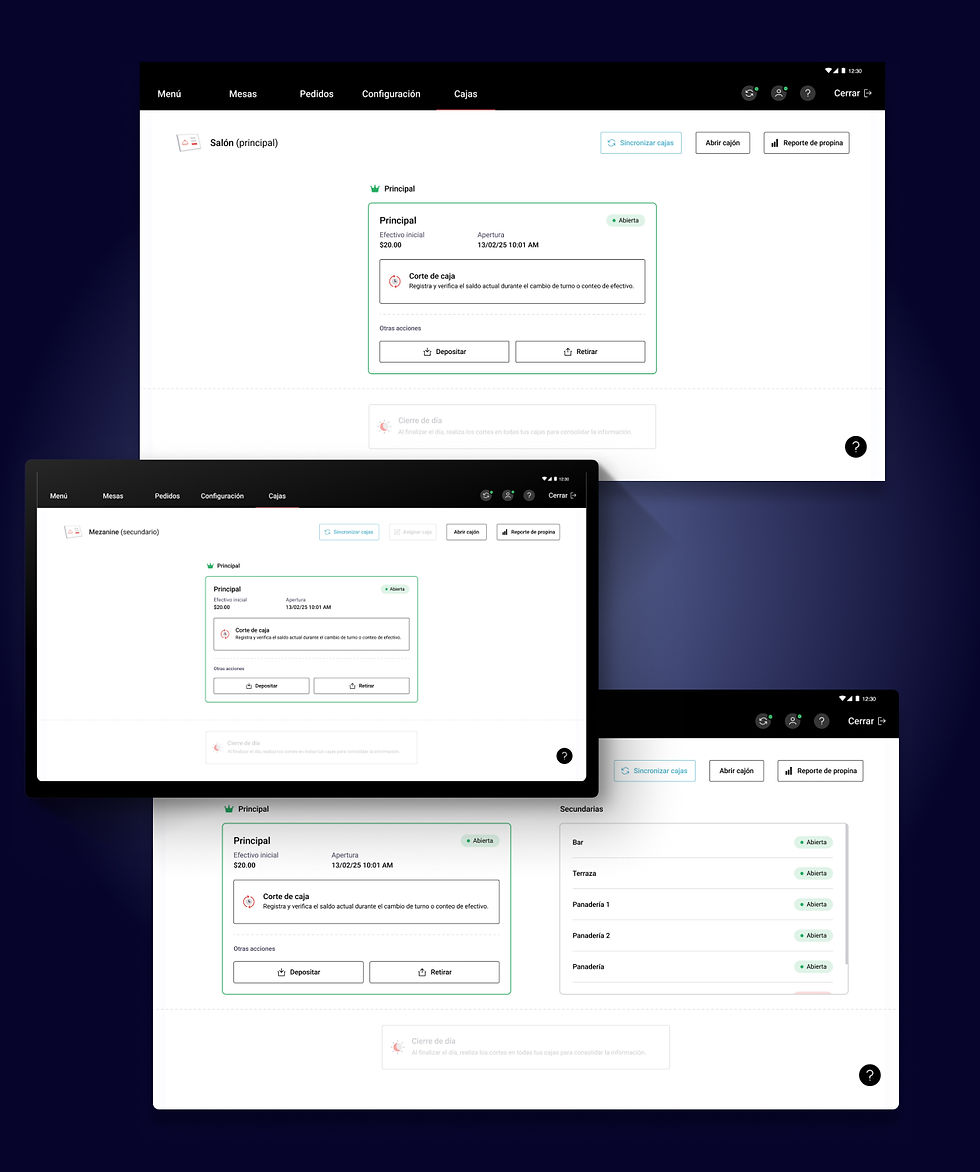
We designed a new flow that allows users to:
-
Choose between mirror register (linked to the main register) or secondary register.
-
Displaying clear warnings if there is no active session (operation blocked).
-
Viewing secondary registers from the main or mirrored POS.
-
Adding, editing, or reverting to the main register from the same screen.
Solution


Impact
-
We simplified operations for large restaurants with multiple POS devices.
-
Enabled new revenue through upselling of cash registers.
-
Unified reporting under one branch, reducing interpretation errors.
Role
Product strategy, flow design, user validation.
Tools
Figma, Maze, CommandAI, ChatGPT, user interviews.
Outcome
More user control, more operational clarity for restaurants.
Research

-
“I just need one more register, not to open another store.”
-
“Reports are duplicated because of the new branch.”
We interviewed restaurant users of different sizes who had requested the feature.
Some insights:
-
If users understood what adding a secondary register meant.
-
If they knew which type of register to select (mirror vs independent).
-
Which button made more sense: “Return to initial configuration” vs “Select secondary register.”
We ran Maze tests with multiple users via CommandAI in the Admin Portal, testing different flows and copy to validate:
Goal
Allow multiple registers per branch (linked to main or secondary POS) without creating fictitious structures, and with unified visibility.
Context
Previously, it wasn’t possible to connect a secondary register to a secondary POS.
For example, if a restaurant had 3 POS devices and 2 cash registers, only one register could be linked to the main POS.
This limitation required setting up a new main POS, forcing restaurants to simulate a “new branch” in order to assign the second register to another POS.
It created operational complexity, duplicated efforts, and fragmented reporting across the system.


Redesigning POS architecture to support multiple registers
We enabled multiple cash registers in a single restaurant to simplify operations and reporting.
Impact: improved reporting, increased cash register sales, and reduced operational friction.
Teams involved: Product, Engineering, Sales, Onboarding, Support, Marketing.